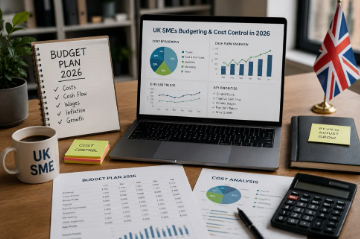
Expansion involves uncertainty.
A business may know that demand is increasing but still be unsure how quickly customers will buy, how much additional staff will cost or when new investment will generate a return.
Financial forecasting helps turn those uncertainties into scenarios that management can evaluate before committing cash.
For UK SMEs planning growth in 2026, forecasting is particularly useful because it brings revenue, expenditure, tax and working-capital requirements into one financial model.
The aim is not to predict the future perfectly. It is to understand what different outcomes could mean for the business.
Begin with a realistic base case
A forecast should start with assumptions that can be explained.
These may be based on:
- Existing customers
- Signed contracts
- Historical sales
- Current pricing
- Supplier costs
- Payroll
- Confirmed investment
Management should document important assumptions rather than entering optimistic numbers without explanation.
This makes it easier to understand why actual performance later differs from the forecast.
Build cash timing into the model
Profit and cash behave differently.
A business may record a profitable sale today but receive the customer payment weeks later.
Meanwhile, staff and suppliers may need to be paid.
The forecast should therefore show when cash is expected to enter and leave the bank.
Working with financial forecasting support for ambitious UK SMEs can help businesses model these timing differences before recruitment, investment or other growth commitments are approved.
Cash timing is often where apparently profitable growth plans become difficult.
Create a downside scenario
Management should not rely only on the expected outcome.
A downside scenario can show what happens when:
- Sales are lower
- Customers pay later
- Costs rise
- Recruitment takes longer
- Marketing performs poorly
The purpose is not pessimism.
It is to understand how much flexibility the business has.
If a relatively small change causes serious cash pressure, the growth plan may require a larger reserve or a more cautious rollout.
Create a high-growth scenario
Faster-than-expected growth can also create problems.
Additional demand may require stock, employees or equipment sooner than planned.
This can increase working-capital requirements before the additional revenue reaches the bank.
A high-growth scenario allows management to estimate how much additional funding may be required if the business performs exceptionally well.
Growth itself can therefore become a financing challenge.
Include recruitment properly
Employees cost more than their salary.
A forecast may also need to consider employer contributions, pension costs, equipment, recruitment and training.
Management should also consider the time before a new employee becomes productive.
The forecast should show the cash impact of recruitment month by month.
This makes it easier to identify whether hiring needs to happen immediately or can be phased.
Include tax and statutory payments
Forecasts can look unrealistically strong when tax is omitted.
Corporation Tax, VAT, PAYE and other relevant liabilities should be included according to their expected timing.
These payments can materially reduce available cash.
Directors should therefore distinguish between the company’s total bank balance and cash that is genuinely available for growth.
Model major capital expenditure
Expansion may require equipment, vehicles, technology or premises.
Large expenditure should appear in the financial model before management commits.
The forecast can show:
- Initial purchase cost
- Financing payments
- Deposits
- Ongoing running costs
- Expected return
This helps the company compare different options.
For example, buying equipment may create a different cash profile from financing or leasing it.
Review customer payment assumptions
Forecasts often assume customers will pay according to contractual terms.
Reality may be different.
Management should use actual payment history where possible.
If customers typically pay ten days later than agreed, the forecast should reflect that behaviour.
The company can also model the benefit of stronger credit control.
Reducing payment delays can sometimes provide additional growth cash without external borrowing.
Compare forecast with actual performance
A forecast should evolve.
Management should regularly compare actual results with the assumptions.
Questions might include:
- Were sales on target?
- Did customers pay when expected?
- Were costs accurate?
- Did recruitment happen on schedule?
- Is the closing cash balance correct?
The forecast should then be updated.
This creates a rolling view of the future rather than relying on assumptions made several months earlier.
Use the forecast before seeking finance
A business considering borrowing or investment should understand exactly what funding is required.
The forecast can show when the cash shortfall occurs and what expenditure causes it.
Management can then explain:
- How much money is required
- What it will fund
- When it will be used
- How the business expects to repay or generate a return
This creates a stronger financial case than simply requesting a general growth fund.
Set minimum cash limits
A company should consider how much cash it wants to retain as a safety buffer.
The appropriate amount depends on the nature of the business and the stability of income.
The forecast can highlight when cash is expected to fall below that level.
Management then has time to reduce spending, improve collections or arrange finance.
Final thoughts
Financial forecasting is one of the strongest tools available to a UK SME preparing to grow.
It allows management to test assumptions before making commitments and shows how sales, costs, tax and working capital interact.
The most useful forecasts include both weaker and stronger outcomes rather than relying on a single prediction.
They are also updated regularly as actual results become available.
Growth will always involve uncertainty.
A good forecast does not remove that uncertainty, but it makes the financial consequences much clearer and gives management more time to respond before cash pressure becomes a problem.